
The Infrastructure Supply Chain Platform
Idencia vision
Platform versus chain
Since the introduction of the assembly line 100 years ago, most industries have operated in a series sequence of production. Each step in the production supply chain is dependent upon successful completion of all steps before it. Today, digital technologies enable industry platforms. Use of platforms shifts the operating dynamic from series sequencing to a parallel system in which parties function independently of any other individual party because they are supported by the platform as a whole. This avoids the trap of the “chain being only as strong as its weakest link” and is critical to unlocking latent productivity improvements.
The infrastructure supply chain that exists today operates in series sequencing and suffers from lagging productivity relative to other industries as a result. The G20 estimates that global infrastructure investment requirements are $94 Trillion through 2040 against identified funding resources of $79 Trillion, leaving a $15 Trillion funding gap that must be closed by productivity improvements.
It is inevitable that the infrastructure supply chain will shift to a common platform to unlock new, unimagined productivity and opportunities. What does this mean? We provide some definition in this report. To start, think how other industries have been transformed by these platforms:


The value of the platform to the infrastructure supply chain will be directly proportional to industry participation. As with the introduction of the telephone, fax machine and iTunes, the platform will become increasingly valuable to users as more parties participate on it.
Idencia is already providing the foundation. We see big things ahead.
A product-centered platform
Product versus project
There are a lot of very good platforms for managing construction projects on the market. All of these have been created to produce efficiencies in managing the project. Other than Idencia’s Connected Concrete™, there are no solutions that place the infrastructure product at the center of the platform. Why is this important? Because...
Products are the infrastructure... leaving them out renders an incomplete solution.
Manufacturing needs a platform... as one of the most complex facets of the supply chain.
Digital product records are essential... to productivity, quality assurance and transparency.
Infrastructure is becoming 'smart'... requiring a platform for managing smart components.
Systems platform
Internal Integration First
The infrastructure product manufacturing industry is highly fragmented and technology adoption has been incremental, applying individual solutions for different segments of company operations. We categorize the solutions into four basic software system sets:
Building Information Modeling (BIM)
Scheduling
Production & Scheduling
Enterprise Resource Management (ERP) and Construction Platforms
Some of these solutions extend from their core into other segments but there is not one solution that serves all of the needs.
Nor should there be. With few exceptions, the software industry has moved away from targeting universal needs (with generally mediocre solutions) to providing very good solutions for specific problems. This makes for better software but leaves the user managing several systems.
As a data collection system, Idencia is well-positioned to stitch the various software systems together with real-time product information. So, our first priority is to evolve into a Systems Platform that collects internal data and integrates with the existing data management systems used by manufacturers:
What will the Systems Platform enable?
The possibilities are endless but here are a few to consider:
-
Precast and prestressed concrete manufacturers produce many products that are required to sit in the yard to cure, typically for a month or more. These yards can be very large (we know several with 40 acres). It is not hard to imagine that conducting physical inventory counts every quarter is arduous and expensive. We have learned from two manufacturers that this can cost as much as $25,000 in consumed time and lost opportunity.
After the counts are taken, all of the information is manually entered into the company’s ERP system. What if they could scan tags instead of counting inventory (reducing the number of people and amount of time required while improving accuracy) and have that information automatically uploaded to the ERP system.
We’re working on that. -
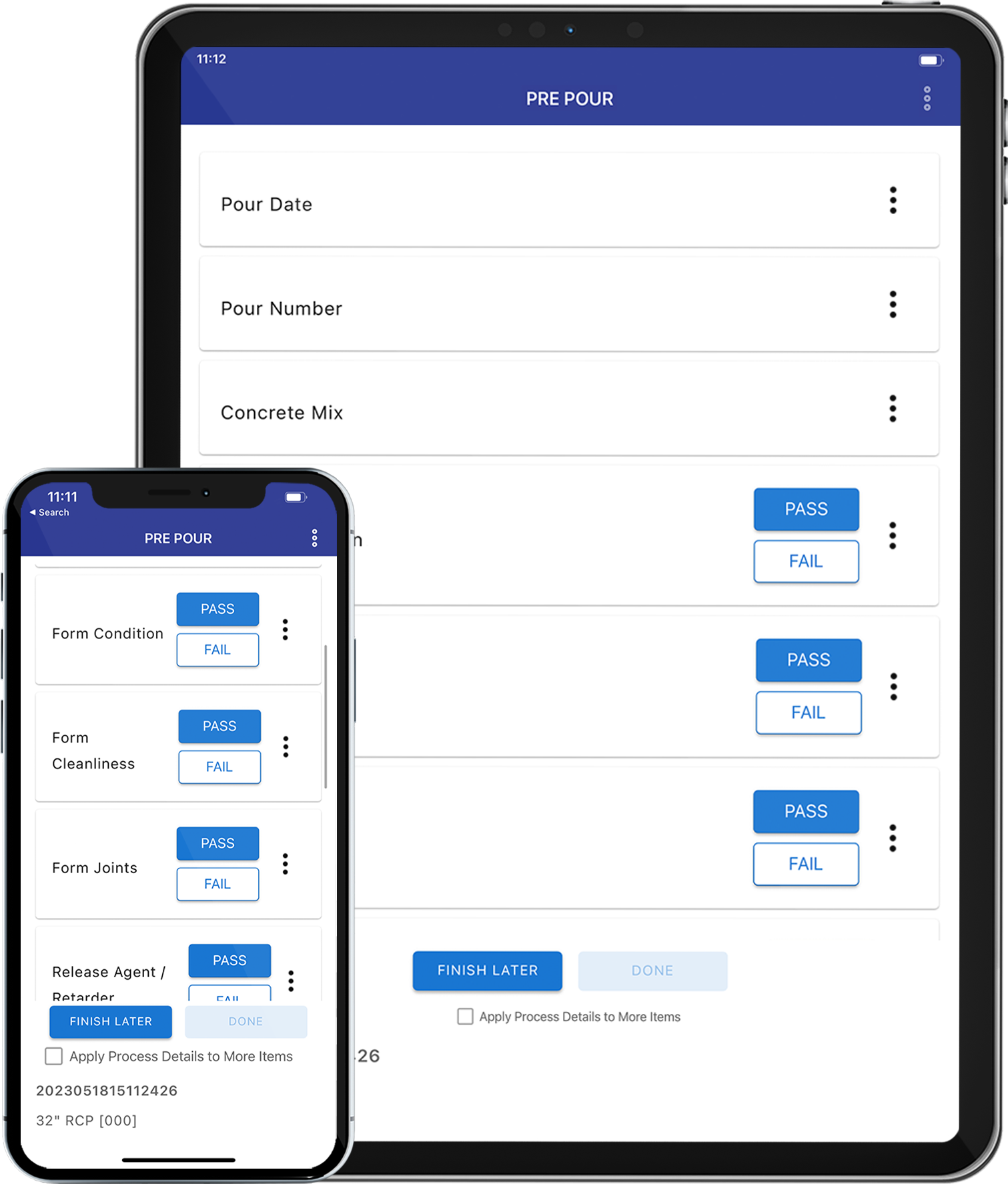
Data is collected during manufacturing using mobile devices and fixed readers that sync to your cloud-hosted account. Your testing equipment (cylinder compression testing machines, for example) produce data that is transmitted to the platform and is combined with the production data to automatically generate comprehensive reports for each piece manufactured.
Idencia is already used to collect the inspection data and we are partnering with a major manufacturer of testing equipment to include test result data as well. -
BIM is now the standard design protocol. One of the reasons for this is that design features are replaced with ”as-built“ data during the construction process. Upon completion, the project owner has a digital twin of the completed project that is enormously useful in managing maintenance. By integrating the BIM model with the platform, ”as-manufactured” product data can be automatically included as well to further enrich the digital twin profile.
We’re working on this too.
Customer platform
Integrating manufacturers with their customers
From the holistic perspective, the primary benefits of an industry platform are that it:
Creates near-seamless engagement between customers and their vendors;
Reduces the friction of commerce between the involved parties; and, as a result
Reduces costs to the consumer.
For the infrastructure supply chain, cost reduction is essential to bridge the global $15 Trillion gap between demand and expected funding resources we described above.
Idencia is already serving manufacturers with product data transfer to their customers, as we will describe below. In the near future, the platform will also enable Smart Infrastructure by providing asset managers with product data produced from sensors embedded in or affixed to the products they purchase from the manufacturer.
This Internet-of-Things (IoT) facility will enable manufacturers who participate on the platform to offer 'smart products' will produce greater customer value, command higher margins and create potential new revenue streams.
It will all start by integrating manufacturers with their customers.
The Customer Platform creates a nice win-win that saves asset managers money while manufacturers can charge more for their products. The North Carolina Department of Transportation estimated that it would save over $1 million annually by requiring all of its concrete vendors to include RFID tags in their products and transmit quality assurance data electronically through Idencia.
What will the Customers Platform enable?
The possibilities are endless but here are a few to consider:
-
The manufacturer collects production data on a mobile device instead of a clipboard. The data is regularly synced with the manufacturer’s web-hosted account and is simultaneously transferred to an account maintained by the manufacturer’s customer. The customer’s IT system calls this information from the account, thus leaving the customer in control.
Idencia is currently providing this service to the precast and prestressed concrete manufacturers selling to the North Carolina Department of Transportation.
-
Currently civil infrastructure inspections are performed manually. The cost is influenced by the frequency required by the Federal Highway Administration (FHWA) and the amount of work to be performed during the inspection. The FHWA inspection frequency will not change but the cost can be reduced if some of the inspection steps are replaced with regular data output from sensors on (or in) structural elements. Further, sensor-equipped RFID tags included in the elements will allow the manual aspect of inspections to be performed more easily and efficiently.
It is estimated that the cost of bridge inspections in the US is $4.6 Billion annually. There is a lot of money to be saved by asset managers from using an infrastructure supply chain platform, even under the assumption that it will not completely replace inspection requirements.
Idencia is currently working with two Boston-area universities and several technology companies to offer these capabilities on our platform.
Vendor platform
Integrating manufacturers with their vendors
Manufacturers can benefit from engaging their vendors on a platform in the same way that their customers benefit. Being part of a tight eco-system, vendors can:
Maintain closer relationships with the manufacturers;
Reduce costs; and
Offer more value to the manufacturers.
In the same way that manufacturers can price their products at a premium AND save their customers money from reduced operating costs, a vendor on the platform can offer this to the manufacturer.
The reason that this can happen is because the platform eliminates costs that do not add value to the customer. Consequently, the manufacturer can save money and the vendor can price the good for full value. If this sounds familiar, it is because this is the fundamental premise of Lean Manufacturing practices.
The platform eliminates costs that do not add value to the customer.
Participation of the manufacturers' vendors will create a complete eco-system working on an electronic platform that reduces costs in the process. Consequently, end users (asset managers) will realize the most benefit from the accumulated savings of all those participating before them in the supply chain.
How will the platform reduce costs for vendors and manufacturers?
-
Barcodes or RFID tags on materials delivered by the vendor to the manufacturer are scanned and automatically entered into the manufacturer’s ERP system. As the infrastructure products are manufactured, the materials consumed are counted and recorded to reflect a real-time value of the amount of materials on hand. Inventory meters can provide real-time views of critical supplies and inventory levels can be automatically updated in the manufacturer’s ERP system.
The vendor will benefit in the same way and will be better able to offer just-in-time deliveries, reducing inventory costs for both parties.
Idencia offers a version of this for managing our customers’ RFID tag inventory levels.
-
Vendors who participate on the platform are preferred by manufacturers over those who do not because they can provide better value. With a critical mass of manufacturers on the platform it is easier for vendors to market and sell to them, thus lowering the cost of customer acquisition to the vendor. Using the platform as a marketing medium further reduces the cost to vendors.
We envision a marketplace on the platform called VendorExchange that will enable vendors to connect more easily with manufacturers directly and by using new apps that are offered through the platform by third parties.
-
By metering material levels using the platform (as described above), the vendor will encourage the manufacturer to re-order in the most timely manner possible. The platform will also be open to financial service partners who provide payment services to participating manufacturers and vendors.
We envision a service called VendorConnect that will accelerate payments and reduce the cost of working capital for participants on the platform.
Conclusion
The Platform Is Revolutionary
The digital platform is as important to future productivity as the assembly line was to manufacturing 100 years ago.
As discussed earlier, we have all experienced this anecdotally as consumers with Amazon, iTunes and Netflix. A deeper dive into the numbers makes the factual case so let's look at iTunes, one of the first consumer platforms.
Two critical principles of 'platform economics' are revealed by studying iTune's impact:
The platform removes costs that do not add value to the customer; and
The platform makes it easier for the customer to do business.
Take notice of the chart, courtesy of Nick Routley from his blog post Visualizing 49 Years of Music Industry Sales.
While music industry revenues did fall, the decline was a result of digital distribution displacing physical distribution of songs recorded on vinyl, cassettes and CDs. The costs of recording on these media and selling through middle parties invested in bricks and mortar were no longer necessary after the introduction of iTunes. Over $12 Billion of savings were realized by consumers as a result of the music industry moving to a digital platform.
As for volume, in just 10 years after the release of iTunes, Apple announced that it had sold 25 billion songs on iTunes. This incredible acceleration was because it was so easy for consumers to purchase with a simple download.
Which brings us to the the final point about platforms:
First adopters thrive while late adopters fail.
Recent history is littered with casualties of companies that did not respond quickly enough to the platform: Borders Books, Sears Roebuck, Blockbuster and most record stores to name just a few. Meanwhile, first adopters are ruling the world.
Idencia is committed to creating a thriving infrastructure supply chain that rises to the challenges... and vast opportunities... of global infrastructure investment over the next 20 years. We hope you will join us.
Idencia in a nutshell
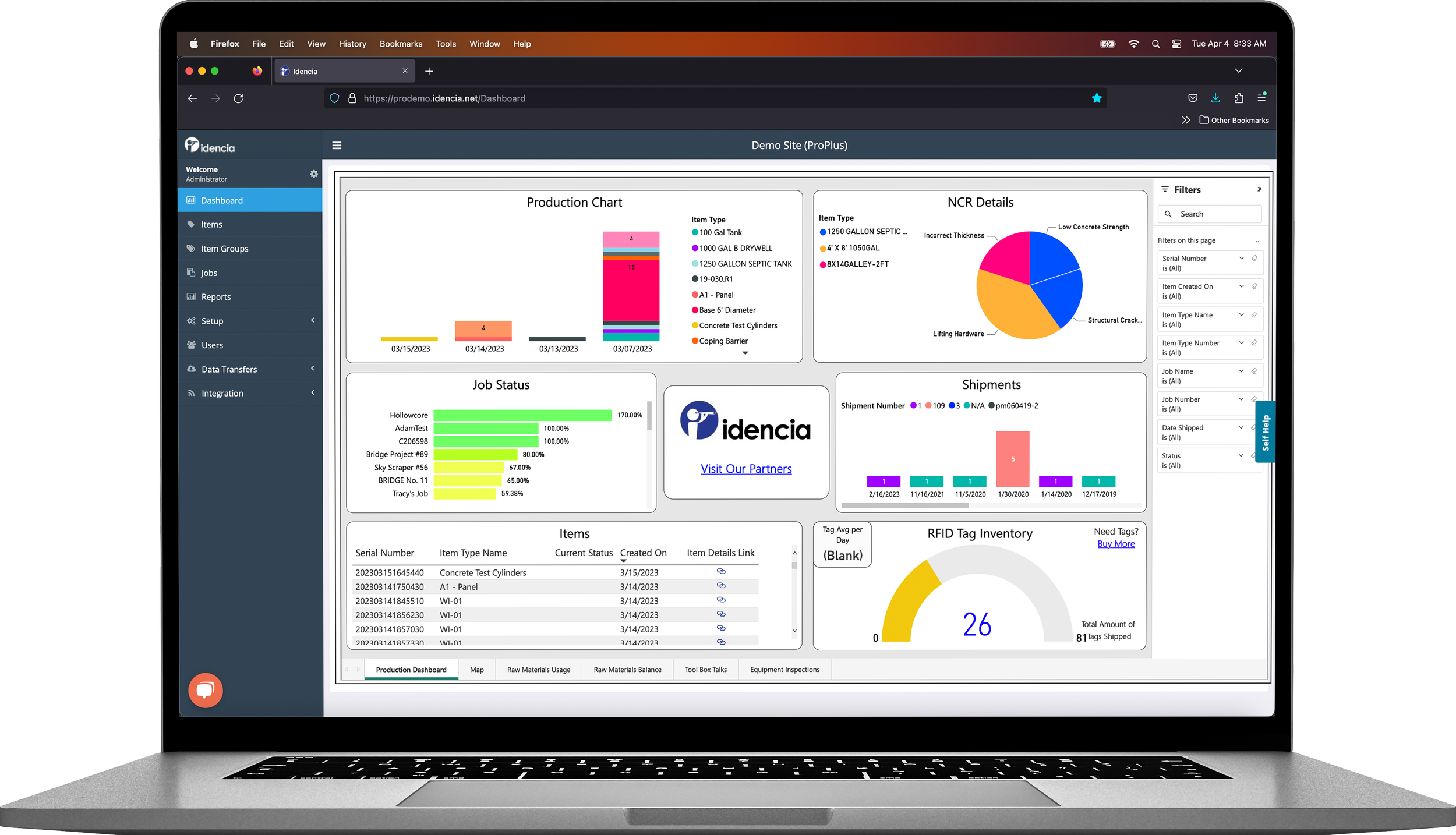
Idencia is a plant management solution that provides tools for plant managers to streamline and optimize their operations. As a company, Idencia strives to benefit the precast concrete industry as a whole.
Contact us
sales@idencia.com
(603) 541-7704